
Exciting news! TCMS official website is live! Offering full-stack software services including enterprise-level custom R&D, App and mini-program development, multi-system integration, AI, blockchain, and embedded development, empowering digital-intelligent transformation across industries. Visit dev.tekin.cn to discuss cooperation!
This article fully presents the entire process of large language models (LLMs) from technological germination to industrial maturity from 2019 to 2026, sorts out key nodes, technical factions, architectural evolution and ecological pattern changes, and deeply interprets the complete context from pre-training and alignment revolution to the popularization of MoE and the rise of domestic models leading the open source field, providing systematic industry reference for AI practitioners.
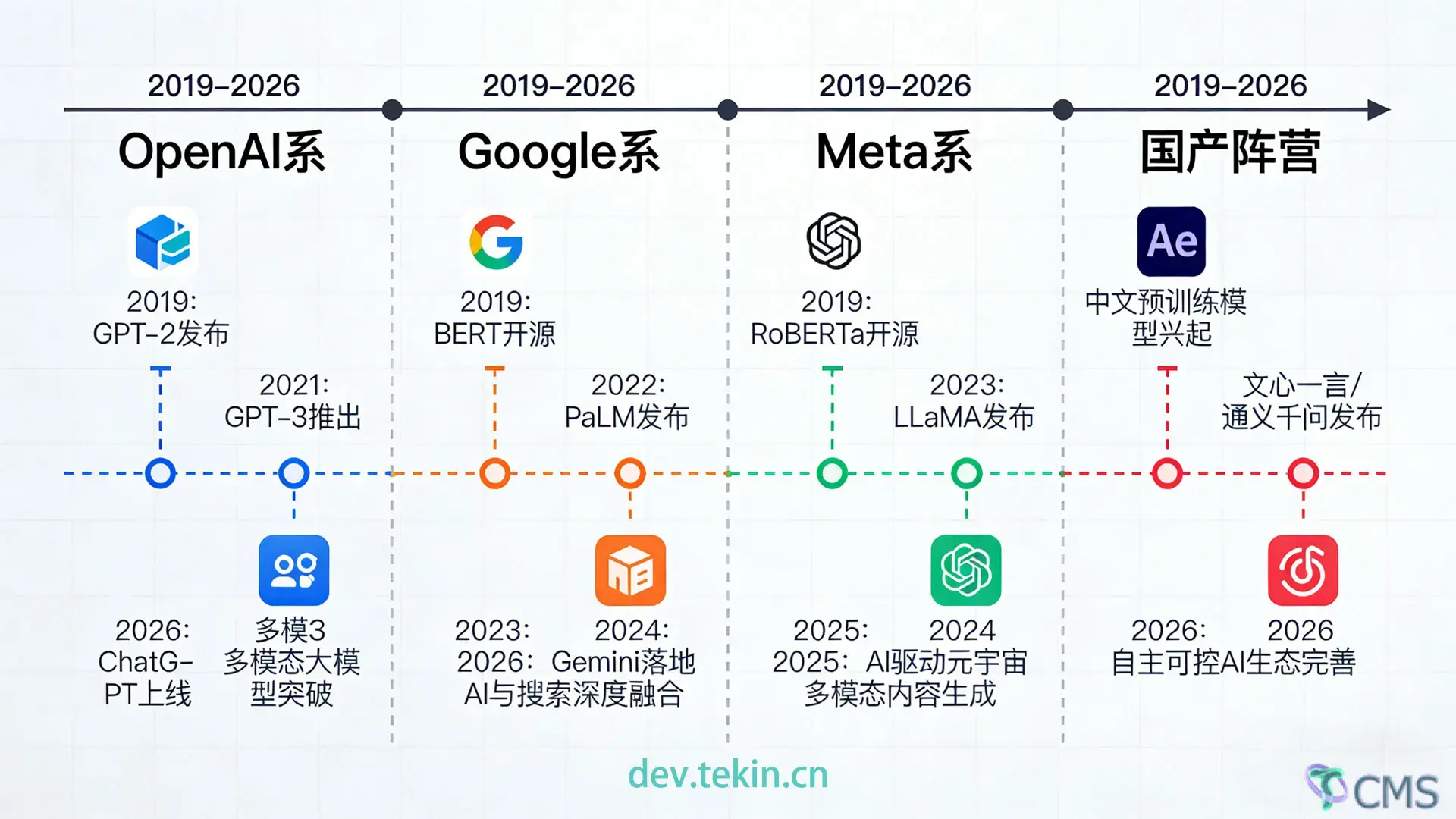
Taking time as the axis, this article systematically sorts out the development history of large language models (LLMs) from 2019 to 2026, focusing on disassembling the core context of the foundation and explosion period (2019-2023) and the ecological maturity period (2023-2026). Combining classic technical maps with the latest industry data, it analyzes the iteration logic of the four major technical factions, interprets key industrial trends such as the popularization of MoE architecture, the rise of Chinese technical strength, and scenario-based segmentation, and constructs a cognitive system of large models with both historical depth and forward-looking value for technical practitioners.
In 2019, the release of GPT-3 marked the official entry of artificial intelligence into the "era of large models"; in 2022, the popularity of ChatGPT brought LLMs from the laboratory to the public; in 2026, the open source ecology flourishes, and domestic models dominate the global pattern. In just seven years, large models have completed the leap from "technological exploration" to "industrial infrastructure", reconstructing the AI R&D paradigm and commercial landscape.
This article will fully restore the evolution of large models from 2019 to 2026 through the division of three stages: foundation period, explosion period and maturity period, clarifying the technical context, faction pattern and the underlying logic of industrial changes.
This stage is the "from 0 to 1" of large models, which has basically completed three core tasks: the establishment of technical paradigm, the outbreak of alignment revolution and the reduction of open source thresholds, laying a solid foundation for the subsequent ecological maturity.
2019 is the "germination year" of large models, and two milestone products have laid the technical foundation for the entire industry:
OpenAI GPT-3: The 175-billion parameter scale set a new record, which first proved that the pre-training mode of "large parameters + massive data" can achieve general language capabilities, becoming the basic prototype of all subsequent generative large models.
Google T5: Put forward the "unified text-to-text" framework, transforming all natural language processing tasks into generation tasks, and providing a new idea for cross-task adaptation.
At that time, large models were still in the "laboratory stage" with extremely high deployment costs and limited application scenarios, but the core paradigm of "pre-training + fine-tuning" had been established, kicking off the R&D competition of large models.
These two years are the "accumulation period" of large models. European and American giants continue to deepen technology research, and domestic players have completed the initial layout, forming a pattern of "European and American leading, domestic following":
Technological iteration of European and American giants: Google launched GShard (a breakthrough in model parallel technology) and mT5 (optimization of multilingual pre-training); OpenAI released Codex, achieving a major breakthrough in code generation and laying the foundation for the subsequent GitHub Copilot.
Initial appearance of domestic models: Huawei PanGu-α and Baidu Ernie 3.0 were successively released, focusing on Chinese scenarios and independent controllability, and conducting differentiated exploration in the directions of knowledge enhancement and multimodal fusion.
Technical characteristics: The parameter scale continued to climb, technologies such as model parallelism and sparsification began to be applied, and large models initially extended from "general capabilities" to "segmented fields".
2022 is the "subversive year" of large models, and the core turning point is the release of ChatGPT, which completely solved the "alignment problem" between large models and human intentions:
First half of the year: Scramble of foundation models: Dozens of foundation models such as Google PaLM, Meta OPT and the first generation of Alibaba Tongyi Qianwen were intensively released, the parameter scale exceeded one trillion, and pre-training technology became increasingly mature.
Second half of the year: RLHF ushers in a new era: Through Reinforcement Learning from Human Feedback (RLHF), OpenAI enabled ChatGPT to accurately understand human instructions and conduct smooth conversations, detonating the consumer market and promoting the transformation of large models from "being able to do things" to "knowing how to do things".
Domestic follow-up: Baidu Wenxin Yiyan, iFlytek Spark Cognitive Large Model and other projects were successively initiated, and the domestic large model competition officially entered the "alignment track".
2023 is the "first year of open source" for large models. Meta's key decision broke the monopoly of giants and promoted the ecology to become civilian-oriented:
Core turning point: Meta open-sourced the LLaMA series models, which, relying on efficient foundation performance and open authorization strategies, became the preferred fine-tuning foundation for developers worldwide.
Outbreak of open source ecology: Fine-tuned models based on LLaMA (such as Vicuna and Alpaca) emerged in large numbers, and domestic open source models (such as Baichuan, InternLM and the open source version of Qianwen 1.0) rose rapidly. "Publicly Available" has become a core trend in the industry.
Technological breakthrough: GPT-4 was released, achieving a major leap in multimodal capabilities; domestic models formed advantages in Chinese understanding and low-cost deployment, initially realizing the transformation from "following" to "keeping pace".
By the end of 2023, large models had completed the pattern transformation from "closed source monopoly" to "open source co-governance", and the technical threshold was greatly reduced, laying the groundwork for the subsequent ecological explosion after 2023.
From the second half of 2023 to 2026, large models entered the maturity period of "from 1 to N". The core logic shifted from "stacking parameters and competing for scale" to "improving efficiency, conducting scenario segmentation and focusing on landing". The rise of Chinese technical strength, the popularization of MoE architecture and scenario-based landing have become the three core characteristics.
The core of this stage is the restructuring of technical routes. The industry has completely bid farewell to "parameter involution" and turned to the technical direction of "efficient activation":
Rise of MoE architecture: Faced with the high inference cost of large parameter models, the Mixture of Experts (MoE) architecture has become the mainstream – through the design of "large total parameters and small activated parameters", it balances performance and cost. Google Gemini 1.0, Zhipu GLM-4, Meta Llama 3 and other models took the lead in adopting the MoE architecture, verifying the feasibility of its industrial landing.
Domestic models overtake on the curve: Domestic models such as Qianwen 2.0 and DeepSeek-V3 have achieved partial surpassing of European and American models in Chinese reasoning and code generation through the optimization of MoE architecture; in the open source ecology, the download volume of domestic models has continued to increase.
Initial scenario-based landing: Large models have begun to shift from "general dialogue" to "industry adaptation". Customized models in finance, government affairs, medical care and other fields have emerged in large numbers, and API calls have become the mainstream commercial model.
2025 is the "year of ecological differentiation" for large models, and the global pattern presents the characteristics of "China leading the open source field, Europe and the United States sticking to the high-end closed source market":
Domestic open source ecology leading the way: Enterprises such as Alibaba, Zhipu AI, DeepSeek and 01.AI continue to iterate open source models, forming absolute advantages in Chinese scenarios, engineering deployment and cost control; the download volume of Chinese open source models on Hugging Face accounts for more than 60%.
Differentiated competition of European and American camps: Meta deepens the LLaMA ecology and consolidates the developer foundation through version iteration; Mistral AI focuses on the European compliance market and launches GDPR-certified models; OpenAI and Google stick to the high-end closed source market, focusing on the flagship performance of GPT-5 and Gemini 2.0.
Outbreak of edge-side large models: With the progress of chip technology, lightweight open source models (such as 7B and 13B parameters) have realized edge-side deployment, and mobile phones, automobiles and IoT devices have become new landing carriers for large models.
In 2026, the ecology of large models has become fully mature, becoming an industrial infrastructure on a par with cloud computing and big data, with the following core characteristics:
Pattern solidification: The open source market has formed a TOP10 pattern of "8 from China and 2 from Europe and the United States" (led by Qianwen 3.5 and GLM-5), and the closed source market is dominated by GPT-5.2 and Gemini 3. The boundary between the two is blurred, forming a business model of "open source foundation + closed source value-added services".
Technological maturity: The MoE architecture has become the absolute mainstream, with activated parameters and inference efficiency reaching the optimal balance; multimodal fusion, agent technology and long text processing have become the core competitive points.
Inclusive landing: Large models have penetrated into all walks of life. Developers can quickly realize AI empowerment through "local deployment of open source models" or "free API calls", and the R&D threshold has dropped to the historical lowest.
Looking at the seven years of development, the global large models have formed four major core factions, each with a clear technical route and industrial positioning, jointly promoting ecological maturity.
| Faction | Core Representative Products | Technical Route Evolution | Industrial Positioning |
|---|---|---|---|
| OpenAI Series | GPT-3 → ChatGPT → GPT-4 → GPT-5.2 | Pre-training → RLHF alignment → Multimodal → Agent | A benchmark in the high-end closed source market with the most mature commercial landing |
| Google Series | T5 → PaLM → PaLM2 → Gemini 3 | Large parameter pre-training → Multimodal fusion → MoE architecture | A technological R&D leader focusing on high-end scientific research and enterprise services |
| Meta Series | OPT → LLaMA → LLaMA2 → LLaMA4 | Closed source foundation → Open source inclusion → MoE ecology → Edge-side adaptation | The foundation of the open source ecology, building a moat for developers worldwide |
| Domestic Camp | PanGu-α → Ernie 3.0 → Qianwen 3.5/GLM-5 | Knowledge enhancement → Chinese alignment → MoE optimization → Scenario-based segmentation | A leader in the open source market, focusing on local landing and independent controllability |
2019-2022: The core is parameter involution, achieving capability breakthroughs by increasing parameter scale and data volume;
2023-2026: The core is efficiency optimization, solving the core contradiction of "performance and cost" from the directions of MoE architecture, sparse inference and edge-side adaptation.
2019-2022: A small number of tech giants master core technologies, and large models are "scarce resources";
2023-2026: The open source wave breaks the monopoly, developers and small and medium-sized enterprises become the core of the ecology, and large models become "public infrastructure".
Early stage: Pursuing "omniscient and omnipotent" general dialogue capabilities for C-end consumers;
Maturity stage: Focusing on scenario-adapted segmented capabilities for B-end enterprises, and scenario-based development has become the key for models to stand out.
From 2019 to 2026, the development of large language models is a dual epic of "technological iteration and industrial transformation". From the establishment of the GPT-3 paradigm, to the ChatGPT alignment revolution, and then to the ecological maturity in 2026, large models have completed a closed loop from "laboratory technology" to "industrial infrastructure".
Today, the dominant position of Chinese strength in the open source market, the comprehensive popularization of MoE architecture, and the in-depth penetration of scenario-based landing mark that large models have entered the "era of inclusiveness". For technical practitioners, there is no need to blindly pursue the "largest model", but to choose the "most suitable model" based on scenario needs – this is the core enlightenment left by seven years of evolution to the industry.
In the future, with the continuous breakthroughs of edge-side large models, agent collaboration and multimodal fusion, large models will further penetrate into every corner of production and life, promoting artificial intelligence to enter a new stage of development.
 Tekin Tian
May 03, 2025

 Tekin Tian
May 03, 2025


Please enter your email address below and click the subscribe button. By doing so, you agree to our Terms and Conditions.