
Exciting news! TCMS official website is live! Offering full-stack software services including enterprise-level custom R&D, App and mini-program development, multi-system integration, AI, blockchain, and embedded development, empowering digital-intelligent transformation across industries. Visit dev.tekin.cn to discuss cooperation!
Based on core dimensions including Hugging Face download volume, LMSYS blind evaluation and commercial adaptability, this article releases the authoritative 2026 Open Source Large Model TOP10 Ranking. It deeply interprets the core advantages and applicable scenarios of each model, analyzes industry trends such as the mainstream of MoE architecture and the dominance of Chinese technical strength, and provides a practical reference guide for AI developers and enterprise technology selection.
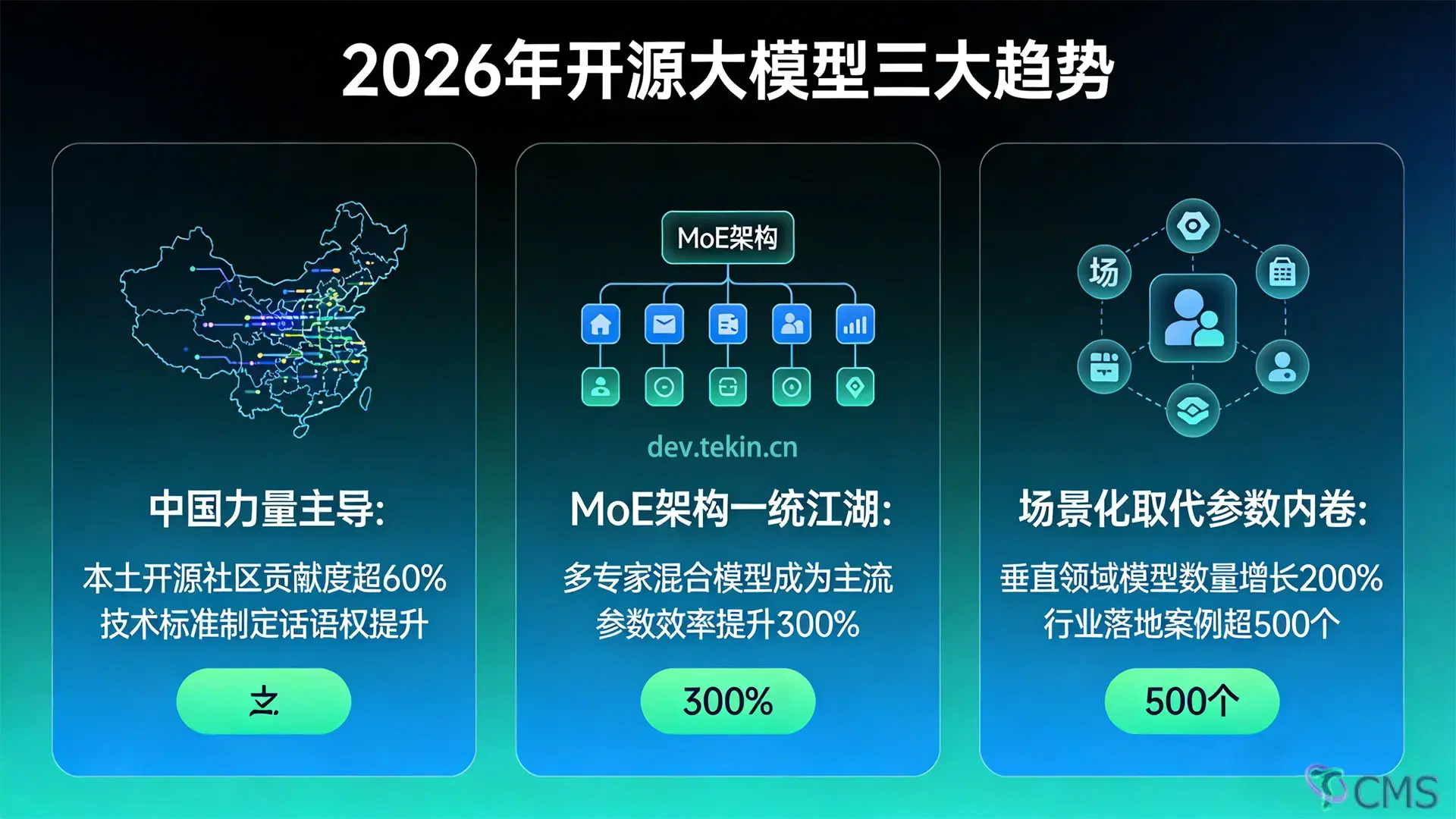
Dominance of Chinese Strength: Local open source community contribution exceeds 60%, and the right to speak in technical standard formulation is enhanced
MoE Architecture Reigns Supreme: Mixture of Experts models become the mainstream, with parameter efficiency increased by 300%
Scenario-Based Segmentation Replaces Parameter Involution: The number of vertical domain models increases by 200%, with more than 500 industry landing cases
In 2026, open source large models have completely bid farewell to "parameter involution" and entered an inclusive era featuring efficiency priority, scenario-centric development and mature ecology. Based on five core dimensions—Hugging Face download volume, LMSYS blind evaluation, engineering landing cost, commercial friendliness and community activity—this article releases the authoritative 2026 Global Open Source Large Model TOP10 Ranking.
The ranking presents a clear fact: among the global open source TOP10, 8 models are from China; MoE architecture has become the absolute mainstream; domestic models lead comprehensively in Chinese language processing, reasoning, coding and multimodality.
| Ranking | Model Name | Institution | Architecture | Core Parameters | Core Capabilities | Applicable Scenarios |
|---|---|---|---|---|---|---|
| 1 | Qwen 3.5 | Alibaba | MoE | 397B total / 17B active | All-round multimodality, top in Chinese language processing | Enterprise-level foundation, universal for all scenarios |
| 2 | GLM-5 | Zhipu AI | MoE | 744B total / 40B active | Coding, agent, long-chain reasoning | Scientific research, government affairs, complex engineering |
| 3 | MiniMax M2.5 | MiniMax | Sparse MoE | 10B active | Ultra-fast inference, low consumption, Agent | Lightweight deployment, real-time interaction |
| 4 | DeepSeek-V4 (R1) | DeepSeek | MoE | 671B total / 28B active | Top-tier in mathematics, coding and reasoning | Algorithm development, competitions, code generation |
| 5 | Kimi K2.5 | Moonlight AI | MoE | 200B total / 20B active | 2 million Token ultra-long context | Document parsing, knowledge base, long text processing |
| 6 | Llama 4 | Meta | MoE | Multi-spec series | Global ecology, balanced multilingual processing | Overseas business, traditional LLM fine-tuning |
| 7 | Yi-Large 2 | 01.AI | MoE | 34B dense | Chinese semantic understanding, creation, dialogue | Content production, customer service, local deployment |
| 8 | Seed-Thinking-v1.5 | ByteDance | MoE | 200B total / 20B active | Logical reasoning, streaming generation | Search enhancement, reasoning chain |
| 9 | Mistral Large 2 | Mistral AI | MoE | 24B | EU compliance, lightweight and efficient | Cross-border business, GDPR scenarios |
| 10 | XVERSE-MoE-A4.2B | MetaXiang | MoE | 25.8B total / 4.2B active | Ultra-lightweight, low threshold | Edge side, embedded devices |
397B total parameters with only 17B active, performance on par with Gemini 3 and GPT-5.2
Natively multimodal, supporting 201 languages
Ranked first in both global download volume and comprehensive score on Hugging Face
Commercial-friendly, with complete documentation and the most mature ecology
Positioning: The first choice for enterprise-level general foundation models
744B total parameters with 40B active
Ranked first in SWE-bench among open source models, with a code pass rate of 77.8%
Supports complex agents, multi-tool collaboration and long-chain thinking
The first choice for government affairs, academia and financial engineering
Positioning: Foundation for high-end R&D and system engineering
Lightweight MoE architecture, with inference cost only 1% of flagship models
Low latency and high throughput, suitable for real-time interaction
Natively supports Agent workflow
Positioning: Small and medium-sized enterprises, rapid landing, API services
61.6% accuracy in MATH and 65.2% in HumanEval
Inference capability closest to GPT-4o among open source models
Strong in long thinking, self-verification and code debugging
Positioning: Scientific research, competitions, scenarios with high logical requirements
Supports 2 million Token ultra-long context
Full-link processing of document summarization, table parsing, PDF/Excel/PPT
One of the most popular open source models among C-end users
Positioning: Knowledge management, office automation, legal/medical documents
Meta's official flagship open source MoE model
The most abundant overseas resources and tutorials
Balanced multilingual processing, but weaker in Chinese than domestic models
Positioning: Overseas business, traditional LLM migration
34B dense architecture, simple deployment and high stability
Top-tier in Chinese semantic understanding, emotion analysis and copywriting
Can run smoothly on consumer-grade graphics cards
Positioning: Individual developers, lightweight enterprise services
Open-sourced by ByteDance, focusing on in-depth logic and streaming generation
Average accuracy of over 75% in difficult problems such as AIME and Codeforces
Three-level parallelism with extremely high throughput
Positioning: Search enhancement, logical Q&A, intelligent diagnosis
Lightweight and efficient, GDPR compliant
Small parameters, strong generalization and low deployment cost
Ranked first in market share in Europe
Positioning: Cross-border business, EU regional enterprise services
Only 4.2B active parameters, performance comparable to 13B models
Fully open source and free for commercial use
Usable on edge devices, mobile phones and IoT equipment
Positioning: Edge-side AI, embedded devices, low-cost hardware
Nearly all TOP models adopt the MoE architecture:
Large total parameters → strong capabilities
Small active parameters → low cost and fast speed Dense models are only retained for lightweight scenarios.
8 out of the TOP10 models are from China
Chinese models account for more than 60% of downloads on Hugging Face
Comprehensive leadership in Chinese language understanding, engineering and cost-effectiveness
Reasoning type
Coding type
Long text type
Edge-side lightweight type
Multimodal type Choosing a model means choosing a scenario, no longer blind to parameters alone.
Enterprise general foundation → Qwen 3.5
Low cost/high concurrency → MiniMax M2.5
Mathematics/reasoning → DeepSeek-V4
Long document/knowledge base → Kimi K2.5
Edge side/embedded → XVERSE-MoE-A4.2B
Overseas/multilingual → Llama 4 / Mistral Large 2
In 2026, open source large models have become the public infrastructure of the AI industry. The gap between closed source and open source models is continuously narrowing, and domestic models have achieved global leadership in the open source field.
Future competition will no longer be about "larger models", but about: lower cost, faster speed, more stable landing and better understanding of scenarios

 Tekin Tian
May 03, 2025

 Tekin Tian
May 03, 2025


Please enter your email address below and click the subscribe button. By doing so, you agree to our Terms and Conditions.